

Sector Analysis — Healthcare: The Medical-Grade Network
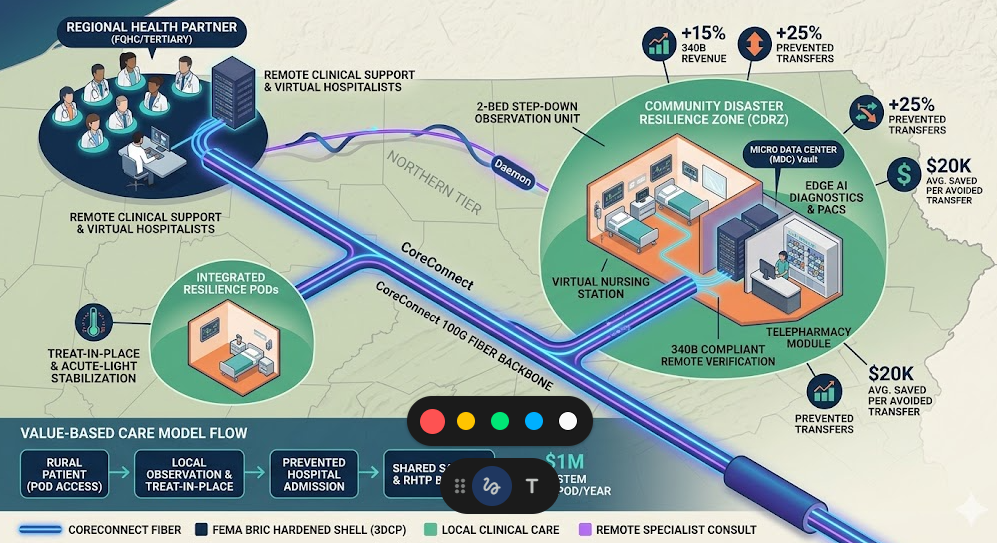
The "Medical-Grade Network" is a paradigm shift in rural health delivery. By integrating high-capacity fiber optics with 3D-printed, disaster-resilient infrastructure, we are creating a localized "Clinical Sovereignty" zone. This network is designed to eliminate the "Rural Penalty"—the high cost and poor outcomes associated with geographic isolation—by bringing Tier-1 medical capabilities directly to the community edge.
The Challenge: The "Rural Penalty"
Rural Pennsylvania currently faces a "Triple Threat" to health stability:
Hospital Deserts: Declining populations and high overhead have led to the closure of acute-care facilities.
Transfer Inefficiency: Avoidable emergency transfers to urban centers (UPMC, AHN) cost the system between $7,500 and $45,000 per event, often for simple observation.
Pharmacy Deserts: A lack of local pharmacies leads to medication non-compliance and lost 340B revenue for regional providers.
The Solution: The Integrated Resilience Pod
Our solution centers on 3D-printed, hardened facilities linked by a 100G fiber backbone. These "Pods" act as a digital and physical extension of a Regional Health Partner.
The Two-Bed Step-Down Unit: A 24-hour observation suite that allows for local "Treat-in-Place" care. Linked via zero-latency fiber to a "Virtual Hospitalist," these beds provide acute-level monitoring without the billion-dollar overhead of a traditional hospital.
Edge Diagnostics & AI: Local Micro Data Centers (MDCs) host high-resolution imaging (PACS) and AI-driven pathology. Diagnostic data is analyzed at the edge with sub-5ms latency, providing instant results for stroke or cardiac triage.
Fiber-Linked Telepharmacy: Automated, remote-verified dispensing units allow a single pharmacist to oversee multiple rural sites, ensuring 340B compliance and medication access in underserved zones.
Financial Projections & Revenue Drivers
The Medical-Grade Network transitions healthcare from a "Cost Center" to an "Economic Engine":
Annual Economic Impact: Estimated at $25M – $35M across the 10-county region.
Value-Based Reimbursement: Under the PA Rural Health Transformation Plan (RHTP), providers earn "Shared Savings" by reducing the "Total Cost of Care." Preventing 100 avoidable transfers per year per pod generates approximately $1M in system value.
CapEx Efficiency: Utilizing FEMA BRIC 90/10 grants for 3D-printed shells allows partners to expand into new counties with near-zero construction debt.
2026 Strategic Roadmap
Pilot Deployment: Launch of 3DCP "Resilience Pods" in designated Community Disaster Resilience Zones (CDRZ) (e.g., Forest and Cameron Counties).
Workforce Integration: Launch of "New Collar" training programs with IUP to certify local Medical Assistants in "Acute-Light" stabilization and tele-presence protocols.
Network Slicing: Implementation of dedicated, encrypted fiber "lanes" to ensure HIPAA data remains physically isolated from public internet traffic.
Conclusion
The Medical-Grade Network is the technological heart of the Northern Tier. It provides the physical security and data velocity required to sustain life in the most remote corners of the Commonwealth, ensuring that a patient's zip code no longer determines their life expectancy.